Learn with Quarter: The Most Popular and Important Front-End Frameworks in 2026
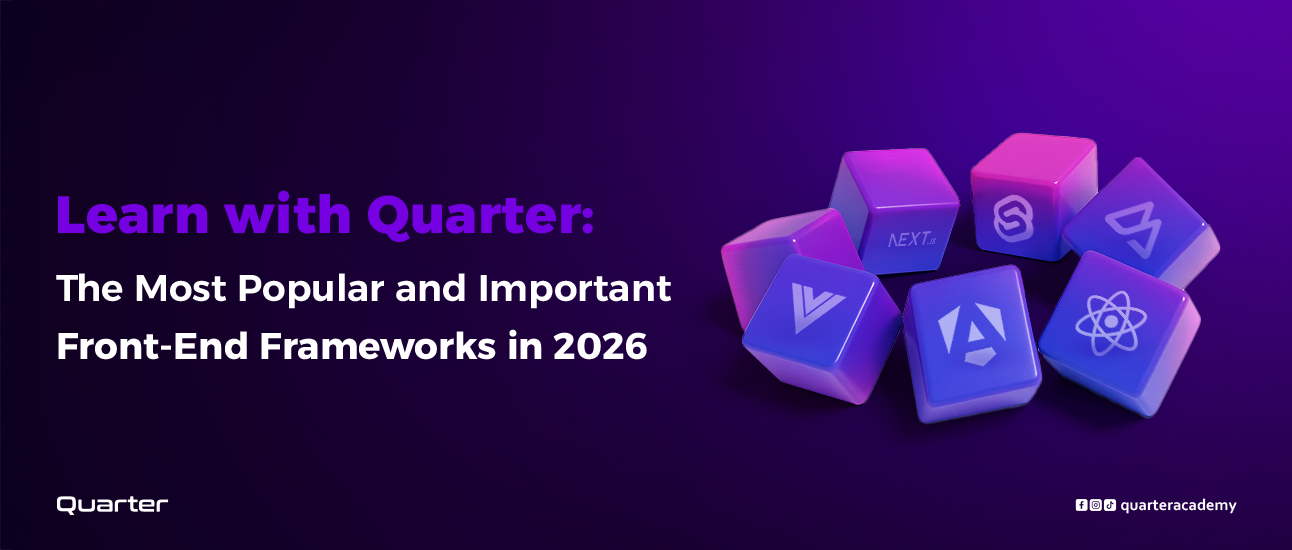
In the world of web development, building user interfaces is no longer just about writing manual code. Relying on the most popular and important Front-End Frameworks has become a necessity for any developer who wants to keep up with market demands. These tools save time, organize code, and give developers the ability to build powerful and highly interactive websites and applications.
In this article, we’ll explore together the most popular and important Front-End Frameworks in 2026.
Why Do You Need Front-End Frameworks?
- Faster Development: With the most popular and important Front-End Frameworks, you can complete large projects in much less time.
- Organized and Maintainable Code: Frameworks make your code cleaner and easier to maintain in teams.
- Enhanced User Experience: Interfaces become more interactive and seamless.
- High Market Demand: Most companies are looking for developers who master the most popular and important Front-End Frameworks.
Angular: The Real Hero in 2026
It’s impossible to talk about the most popular and important Front-End Frameworks without mentioning Angular.
- Backed by Google: Ensuring continuous updates and strong support.
- Built on TypeScript: Which gives code more precision and makes debugging easier.
- Ideal for Large-Scale Projects: Enterprises rely on it due to its strong structure and scalability.
- Bright Career Prospects: Mastering Angular opens doors to local, regional, and international job opportunities.
That’s why Angular is ranked among the most popular and important Front-End Frameworks and one of the most in-demand tools in 2026.
React: The Most Widely Used
Despite Angular’s strengths, React still holds a major spot on the list of the most popular and important Front-End Frameworks.
- Known for its simplicity and ease of learning.
- A massive community that provides endless resources and tools.
- High flexibility for building interactive applications.
Vue.js: The Best Option for Beginners
Among the most popular and important Front-End Frameworks, Vue.js is considered a lightweight and beginner-friendly option:
- Perfect for those just starting out in programming.
- Combines the best features of Angular and React.
- Highly effective for small to medium projects.
Other Notable Tools in 2026
- Svelte: A rising framework that continues to gain traction.
- Next.js & Nuxt.js: Excellent for building SEO-friendly websites.
All of these fall under the umbrella of the most popular and important Front-End Frameworks that open up countless career opportunities.
How Do You Choose the Right Framework?
- Project Size: Angular is great for large projects, while React or Vue are perfect for smaller or faster builds.
- Market Needs: Some companies prefer Angular, others React.
- Your Current Level: If you’re a beginner, start with Vue or React.
Why Learn the Most Popular and Important Front-End Frameworks with Quarter Academy?
- Hands-on Learning with Modern Curricula.
- Trainers with Market Experience.
- Real-world Projects to build a strong portfolio.
- Special Focus on Angular as one of the most powerful and in-demand frameworks in 2026.
Learning the most popular and important Front-End Frameworks is no longer optional—it’s a must for every developer aiming for a strong career. Angular remains the standout framework, but React and Vue.js are also essential tools.
With Quarter Academy, you don’t just learn; you build a digital future. Their practical, project-based approach prepares you for the job market from day one.
Tags
related articles
view all
How to Benefit from Quarter Academy Courses to Learn Programming?
Programming has become one of the most in-demand skills in both the Saudi and global job markets. With the rapid digital transformation and the increasing reliance on applications and websites, learning programming has become a guaranteed path to achieving a high income and exceptional job opportunities.
If you want to learn programming from scratch to a professional level, Quarter Academy offers you the best training courses that ensure you master the skills needed to enter the world of programming with strength, whether you’re aiming for a prestigious job or prefer freelancing.
Why Choose Quarter Academy Courses to Learn Programming?
Quarter Academy courses provide a comprehensive curriculum that covers all levels—whether you are a beginner or an experienced professional, you will find a course that suits your level. The courses emphasize practical learning through real projects, ensuring you deeply understand programming concepts. Professional trainers guide you step by step until you become a qualified programmer for the job market. Moreover, the accredited certificates you earn enhance your job opportunities and help you stand out among competitors. Additionally, the flexibility to attend courses online from anywhere at any time makes learning convenient.
How to Benefit from Quarter Academy Courses to Learn Programming?
Choose the Right Programming Field for You
Before starting, determine which programming field you want to specialize in based on your interests and available job opportunities.
- If you want to develop websites, you need to learn:
- HTML, CSS, JavaScript (Front-End)
- Node.js, PHP, Python (Back-End)
- If you want to develop mobile applications, start by learning:
- Swift for iOS app development
- Kotlin and Java for Android app development
- If you are interested in data analysis and artificial intelligence, learn:
- Python, SQL, Machine Learning
- If you want to enter the world of gaming, begin with:
- C# with Unity
- Tip: Quarter Academy offers specialized courses in all these fields, making it easier for you to choose the course that suits you.
- Enroll in the Courses Offered by Quarter Academy
- Once you’ve chosen your field, enroll in the appropriate course. Quarter Academy offers a variety of courses suitable for all levels, such as:
- Full-Stack Web Development Course:
- Learn website design and development using HTML, CSS, JavaScript, and React.js; how to build dynamic websites using Node.js and MongoDB.
- iOS App Development Course Using Swift:
- Learn the fundamentals of Swift and build professional apps using Xcode; discover how to publish your apps on the Apple Store and earn profits.
- Android App Development Course Using Java and Kotlin:
- Learn to create professional Android applications using Kotlin and Java; design fast apps that work on all devices.
- Data Analysis and Artificial Intelligence Course:
- Learn Python and SQL for data extraction and analysis; build machine learning models and analyze big data.
- C# and Game Development with Unity Course:
- Learn 3D game programming using Unity and C#; design and launch your own games across various platforms.
- Learn Through Practical Projects and Real Applications
- One of the most important features of Quarter Academy courses is their emphasis on practical application rather than just theoretical explanations.
- During the courses, you will:
- Build fully integrated websites from scratch to professionalism.
- Design and program mobile apps ready for launch.
- Analyze data using Python and SQL.
- Program interactive games using Unity.
- Working on real projects ensures you gain a deep understanding of the programming skills required in the job market
Obtain an Accredited Certificate to Enhance Employment Opportunities
After completing the course, you will receive an accredited certificate from Quarter Academy, which increases your chances of landing a prestigious job in major tech companies.
Benefits of Accredited Certificates:
- They increase your credibility with employers.
- They make you more competitive in the job market.
- They help you easily apply for programming positions.
- Build a Strong Portfolio to Attract Employers
- One of the most crucial factors for success in the programming job market is having a “portfolio” that showcases your practical projects.
- How to Build a Strong Portfolio:
- Add the projects you worked on during the courses.
- Include your GitHub link to share your code.
- Create a personal website to display your projects and past work.
- Share your projects on platforms like LinkedIn and Behance.
- All these steps will help you stand out when applying for programming jobs.
- Join the Programmer Community and Interact with Peers
- Networking with other developers helps you improve your skills and secure new job opportunities.
Where to Join Programming Communities:
- GitHub: To share your projects.
- Stack Overflow: To get solutions for coding issues.
- LinkedIn: To network with professional programmers and company leaders.
- Quarter Academy Communities: Where you can benefit from the expertise of trainers and professional programmers.
- Search for Jobs and Apply
- Once you have gained the necessary skills and hands-on experience, you can apply for programming jobs in Saudi Arabia through job websites such as:
- LinkedIn Jobs
- Bayt.com
- Wuzzuf
- Freelance platforms like Upwork and Fiverr
- Quarter Academy also assists in preparing you for job interviews, which increases your chances of securing a programming position.
If you want to learn programming in a professional and practical manner, Quarter Academy provides you with the best training courses to prepare you for the job market. Whether you are a beginner or a professional, you will find the right course for you, complete with hands-on training, real projects, and accredited certificates.
Start your programming journey today with Quarter Academy and be part of the future of technology!
From Idea to Implementation: Steps to Create a User Flow that Elevates User Experience Quality
In the world of UI/UX design, it’s not enough to craft a beautiful interface; the priority is to build a clear, frictionless user experience from the very first entry point to goal completion. This is where the steps to create a User Flow come in—a pivotal tool that enables the designer to translate ideas into actionable paths that precisely mirror the user journey.
In this article, we’ll walk step-by-step through the steps to create a User Flow scientifically and methodically to raise experience quality and deliver an effective product.
Why is a User Flow important?
- It maps the path: it shows users how to reach their goal with minimal effort.
- It reduces errors: defining the path early helps you avoid complexities during development.
- It saves time: instead of fixing design mistakes after implementation, you set things right from the start through the steps to create a User Flow.
Steps to Create a User Flow Scientifically
1) Define business and user goals
Before any sketching or planning, ask: What is the core goal of the app or site? What does the user want to accomplish?
This stage is foundational—without it, any User Flow will be incomplete.
2) Collect data and research (User Research)
Don’t start designing based on assumptions. Conduct user interviews, observe behavior, and analyze competitors.
These inputs help you determine the most accurate steps to create a User Flow, grounded in reality rather than guesswork.
3) Identify entry points
Where can the user come from?
- From Google
- From an ad
- From a sign-in screen
- Identifying these points is essential to clearly draw the beginning of the User Flow.
4) Map scenarios
For each user goal, map a full scenario. Example:
Goal: purchase a product
Scenario: search → add to cart → checkout → confirmation
These scenarios later become part of the steps to create a User Flow.
5) Draw the diagram (User Flow Diagram)
Use tools like Figma or Miro to map:
- Screens
- Actions
- Decisions
- Outcomes
- Every arrow or step in the diagram must clearly indicate the next stage.
6) Validate simplicity
One of the most important rules in the steps to create a User Flow: Keep it simple.
If a user needs six taps to reach a goal, reduce them to three. Simplicity = better UX.
7) Test with users (Usability Testing)
Sketch your flow and show it to real users before implementation. You’ll uncover issues you might have missed.
8) Continuous iteration
A User Flow isn’t static; review and refine it based on test results and post-launch behavior.
Tools that help with the steps to create a User Flow
- Figma: ideal for interactive design.
- Miro: great for team collaboration.
- Whimsical: simple and fast for flow diagrams.
Common mistakes when creating a User Flow
- Skipping research and relying on guesswork.
- Overcomplicating paths in a way that exhausts the user.
- Forgetting entry and exit points.
- Not testing the flow with real users.
The success of any digital product begins with understanding the user and building a clear, seamless journey. By following the steps to create a User Flow scientifically, you ensure:
- An integrated user experience
- Fewer late-stage errors
- Faster achievement of project goals
A User Flow isn’t just a diagram—it’s the roadmap that turns your concept into a successful implementation.

A Comprehensive Guide to Learning Programming with Python
Programming has become one of the most sought-after skills in today's world. Whether you aim to work as a professional programmer, develop applications, or analyze data, Python is the perfect starting point for beginners due to its simplicity and versatility. In this article, we’ll guide you through how to begin learning Python, answer common questions about programming, and provide strategies to enhance your skills and achieve your goals.
Why Python?
1. Easy to Learn:
Python is one of the easiest programming languages for beginners, thanks to its simple and English-like syntax.
2. Versatile:
Python can be used for web development, data analysis, artificial intelligence, and even game development.
3. Abundant Resources:
There are plenty of free and paid resources to help you learn Python quickly.
Is Programming Difficult or Easy to Learn?
Programming might seem challenging at first, but with consistent practice and dedication, it becomes an easily mastered skill. Python, in particular, is ideal for beginners due to its straightforward structure and large supportive community that offers solutions and advice.
Tips to Make Learning Easier:
Dedicate daily time to learning and practicing.
Start with small projects to apply what you’ve learned.
Join online programming communities for support.
How to Start Your First Programming Project?
1. Choose a Simple Idea:
Begin with a small project, such as creating a calculator app, a text analysis program, or an expense tracker.
2. Use Python Libraries:
Tkinter: For building user interfaces.
Pandas: For data analysis.
Matplotlib: For data visualization.
3. Test Your Project:
Debug your code and learn from errors—this is an essential part of programming.
Strategies for Continuous Learning in Programming
1. Daily Practice:
Dedicate at least 30 minutes daily to learning and writing code.
2. Solve Programming Problems:
Use platforms like HackerRank and LeetCode to improve problem-solving skills.
3. Contribute to Open Source Projects:
Contributing to open-source projects provides hands-on experience and helps you build a professional network.
4. Invest in Educational Courses:
Enroll in courses like Quarter Academy’s Python Course for comprehensive and guided learning.
How to Become a Professional Web Developer?
1. Learn the Basics:
Start with foundational languages like HTML, CSS, and JavaScript.
2. Master Python for Web Development:
Use frameworks like Django and Flask to build professional-grade websites.
3. Build Practical Projects:
Develop a website or web application to showcase your skills.
4. Learn Database Management:
Familiarize yourself with databases like PostgreSQL and MySQL.
Quarter Academy's Python Course
Quarter Academy offers a comprehensive Python course tailored for beginners and professionals alike.
Course Highlights:
- Comprehensive coverage of basics with practical applications.
- Real-world projects to apply what you’ve learned.
- Full support from professional instructors.
- Flexible online learning to fit your schedule.
- What You’ll Learn:
- Writing code using Python.
- Developing simple and advanced applications.
- Analyzing data with libraries like Pandas and NumPy.
- For more details, visit Quarter Academy’s website.
FAQs
1. What’s the best way to learn Python?
Start with a comprehensive course like Quarter Academy’s Python Course and dedicate daily time to practice.
2. Is Python suitable for beginners?
Yes, Python is one of the easiest programming languages for beginners due to its simplicity and extensive learning resources.
3. Can I use Python for web development?
Absolutely! Frameworks like Django and Flask allow you to develop professional web applications.
4. How long does it take to learn Python?
You can learn the basics in 6-8 weeks with consistent effort.
5. Do I need a powerful computer to program?
No, any modern computer with a browser and internet connection is sufficient to get started.
Learning programming with Python is your gateway to a world full of opportunities. Thanks to its simplicity and wide range of applications, you can confidently start your programming journey. Don’t forget to take advantage of high-quality courses like Quarter Academy’s Python Course, and start today to achieve your professional goals!
'%3e%3cpath%20d='M0%2024.8857L1.69627%2018.6619C0.647564%2016.8351%200.0974211%2014.7662%200.103152%2012.6513C0.103152%206.02399%205.46704%200.635742%2012.0516%200.635742C15.2493%200.635742%2018.2521%201.88628%2020.5043%204.15683C22.7622%206.42739%2024.0057%209.44711%2024%2012.657C24%2019.2843%2018.6361%2024.6725%2012.0458%2024.6725H12.0401C10.0401%2024.6725%208.07449%2024.1654%206.32664%2023.2088L0%2024.8857ZM6.63037%2021.0362L6.9914%2021.2552C8.51575%2022.1657%2010.2636%2022.644%2012.0458%2022.6498H12.0516C17.5243%2022.6498%2021.9828%2018.172%2021.9828%2012.6628C21.9828%209.99458%2020.9513%207.48775%2019.0773%205.59754C17.2034%203.70733%2014.7049%202.67002%2012.0516%202.67002C6.57879%202.66426%202.12034%207.14198%202.12034%2012.6513C2.12034%2014.5357%202.64183%2016.374%203.63897%2017.9646L3.87392%2018.3449L2.87106%2022.0274L6.63037%2021.0362Z'%20fill='white'/%3e%3cpath%20d='M0.417969%2024.4653L2.05694%2018.4546C1.04261%2016.697%200.509659%2014.6973%200.509659%2012.6572C0.51539%206.26048%205.69017%201.05664%2012.0512%201.05664C15.14%201.05664%2018.034%202.26684%2020.2117%204.45671C22.3893%206.64659%2023.587%209.56258%2023.587%2012.663C23.587%2019.0597%2018.4065%2024.2636%2012.0512%2024.2636H12.0455C10.1142%2024.2636%208.21739%2023.7737%206.53258%2022.8517L0.417969%2024.4653Z'%20fill='url(%23paint0_linear_2746_57609)'/%3e%3cpath%20d='M0%2024.8857L1.69627%2018.6619C0.647564%2016.8351%200.0974211%2014.7662%200.103152%2012.6513C0.103152%206.02399%205.46704%200.635742%2012.0516%200.635742C15.2493%200.635742%2018.2521%201.88628%2020.5043%204.15683C22.7622%206.42739%2024.0057%209.44712%2024%2012.657C24%2019.2843%2018.6361%2024.6725%2012.0458%2024.6725H12.0401C10.0401%2024.6725%208.07449%2024.1654%206.32664%2023.2088L0%2024.8857ZM6.63037%2021.0362L6.9914%2021.2552C8.51575%2022.1657%2010.2636%2022.644%2012.0458%2022.6498H12.0516C17.5243%2022.6498%2021.9828%2018.172%2021.9828%2012.6628C21.9828%209.99458%2020.9513%207.48775%2019.0773%205.59754C17.2034%203.70733%2014.7049%202.67002%2012.0516%202.67002C6.57879%202.66426%202.12034%207.14198%202.12034%2012.6513C2.12034%2014.5357%202.64183%2016.374%203.63897%2017.9646L3.87392%2018.3449L2.87106%2022.0274L6.63037%2021.0362Z'%20fill='url(%23paint1_linear_2746_57609)'/%3e%3cpath%20fill-rule='evenodd'%20clip-rule='evenodd'%20d='M9.06551%207.62598C8.84202%207.12461%208.60706%207.11309%208.39503%207.10733C8.22311%207.10156%208.02253%207.10156%207.82196%207.10156C7.62139%207.10156%207.30047%207.17648%207.0254%207.47615C6.75033%207.77581%205.98242%208.50193%205.98242%209.98298C5.98242%2011.4583%207.05405%2012.8874%207.20305%2013.0891C7.35205%2013.2908%209.27182%2016.4201%2012.3033%2017.6245C14.8248%2018.6272%2015.3406%2018.4255%2015.885%2018.3737C16.4294%2018.3218%2017.65%2017.6475%2017.9022%2016.9445C18.1486%2016.2414%2018.1486%2015.6421%2018.0741%2015.5153C17.9996%2015.3885%2017.799%2015.3136%2017.501%2015.1638C17.203%2015.0139%2015.736%2014.2878%2015.4609%2014.1841C15.1859%2014.0861%2014.9853%2014.0343%2014.7904%2014.3339C14.5899%2014.6336%2014.0168%2015.3078%2013.8449%2015.5095C13.673%2015.7112%2013.4953%2015.7343%2013.1973%2015.5845C12.8993%2015.4346%2011.9366%2015.1177%2010.7962%2014.0919C9.90792%2013.2966%209.3062%2012.3112%209.13428%2012.0115C8.96236%2011.7118%209.11709%2011.5505%209.26609%2011.4006C9.39789%2011.2681%209.56408%2011.0491%209.71308%2010.8762C9.86207%2010.7033%209.91365%2010.5766%2010.0111%2010.3749C10.1085%2010.1732%2010.0626%2010.0003%209.98815%209.85043C9.91365%209.70636%209.32912%208.21955%209.06551%207.62598Z'%20fill='white'/%3e%3c/g%3e%3cdefs%3e%3clinearGradient%20id='paint0_linear_2746_57609'%20x1='12.0019'%20y1='24.4641'%20x2='12.0019'%20y2='1.05582'%20gradientUnits='userSpaceOnUse'%3e%3cstop%20stop-color='%2320B038'/%3e%3cstop%20offset='1'%20stop-color='%2360D66A'/%3e%3c/linearGradient%3e%3clinearGradient%20id='paint1_linear_2746_57609'%20x1='12.0023'%20y1='24.8835'%20x2='12.0023'%20y2='0.635742'%20gradientUnits='userSpaceOnUse'%3e%3cstop%20stop-color='%23F9F9F9'/%3e%3cstop%20offset='1'%20stop-color='white'/%3e%3c/linearGradient%3e%3cclipPath%20id='clip0_2746_57609'%3e%3cpath%20d='M0%204.63574C0%202.4266%201.79086%200.635742%204%200.635742H16C20.4183%200.635742%2024%204.21746%2024%208.63574V16.8857C24%2021.304%2020.4183%2024.8857%2016%2024.8857H4C1.79086%2024.8857%200%2023.0949%200%2020.8857V4.63574Z'%20fill='white'/%3e%3c/clipPath%3e%3c/defs%3e%3c/svg%3e)


Courses
Subscribe
make the right move for your future.
Powered By

© 2026 Quarter. All Rights Reserved